Last Updated on August 25, 2026 by Christian Heide
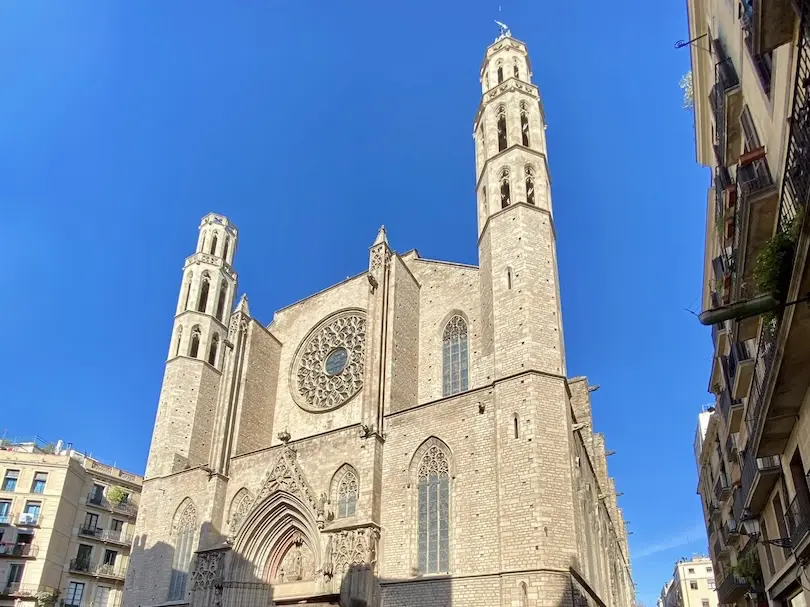
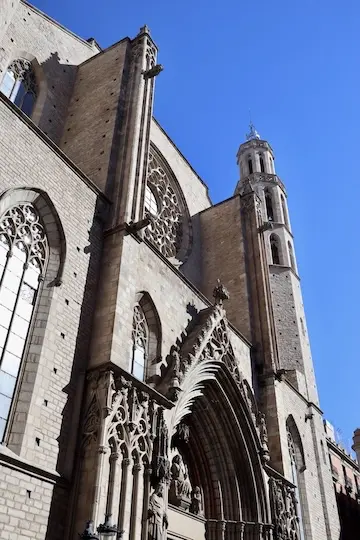
Santa Maria del Mar is tucked away in the labyrinth of streets in El Born, and at first glance, its exterior seems almost a little forbidding: massive stone walls, tall towers, and a simple Gothic façade.
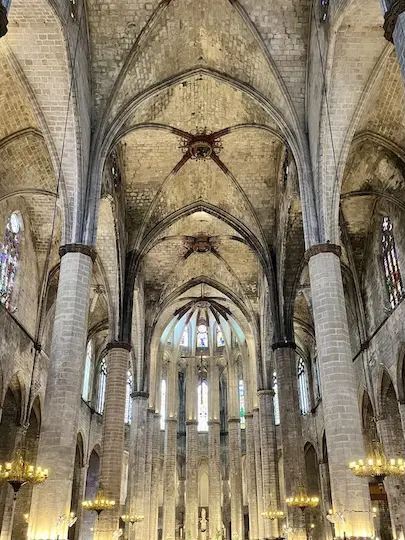
But as soon as you step through the portal, the impression changes completely. Suddenly, a vast, bright space opens up. Tall columns stretch upward, light pours through the colorful stained-glass windows, and the clear architecture feels both powerful and amazingly light.
For us, Santa Maria del Mar is one of the churches in Barcelona that you simply must visit. Its history reveals much about the city, its people, and their connection to the Mediterranean. And if you’ve read Ildefonso Falcones’ novel The Cathedral of the Sea, you’ll likely experience this place in a whole new light.
A Church Built by the People
Santa Maria del Mar was constructed in the 14th century, a time when Barcelona had become a major trading and maritime power in the Mediterranean. The La Ribera district was then located right by the sea and was home to merchants, sailors, craftsmen, and dockworkers.
In 1329, the foundation stone for the current basilica was laid. Berenguer de Montagut and Ramon Despuig were commissioned to oversee its construction. What is particularly remarkable is the speed at which the church was built: by 1383, the final stone was already in place. The construction took just around 54 years.
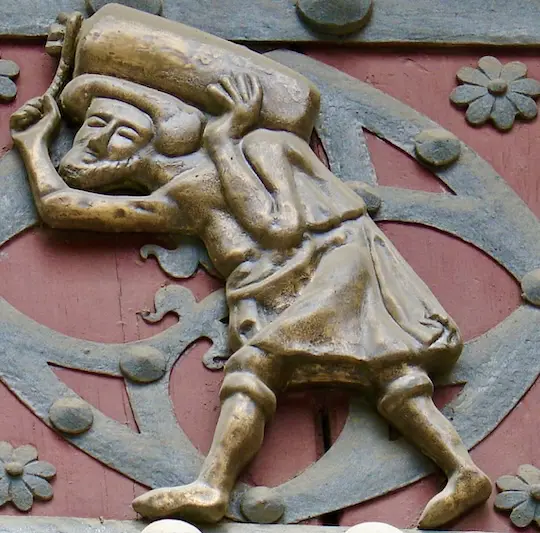
However, Santa Maria del Mar was not a project funded solely by the nobility and the Church. The residents of La Ribera were directly involved. They donated money or contributed their labor. A particularly important role was played by the Bastaixos, the port’s stevedores. They transported the heavy stones from Montjuïc, which served as a quarry at the time, to the construction site. Their work is immortalized in the church to this day—among other places, on the entrance doors. It is precisely this connection to the people of the district that explains its nickname, the “Cathedral of the People.”
And although Santa Maria del Mar is not officially a cathedral, this name fits remarkably well. The church was an expression of the pride of the people who lived and worked in La Ribera at the time.
Why Santa Maria del Mar Feels So Special Inside
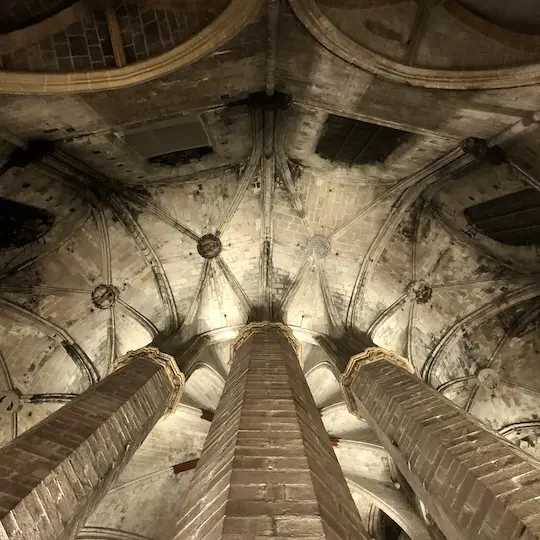
From the outside, the basilica appears massive and almost fortress-like. But inside, you’ll find something entirely different. The three naves are designed with an unusual harmony. Powerful octagonal columns support the vaults and are spaced so far apart that the interior feels surprisingly open. There is little unnecessary decoration. Instead, stone, light, and proportions dominate. That’s precisely what makes Santa Maria del Mar so fascinating to us.
While other Gothic churches impress with an abundance of altars, sculptures, and ornaments, this basilica feels almost minimalist. The eye can wander freely through the space. However, the current simplicity isn’t entirely original. A devastating fire in 1936, during the Spanish Civil War, destroyed much of the interior furnishings. Many stained-glass windows were also lost. Yet, some historical windows were saved, including the 15th-century window depicting the Last Judgment, as well as windows illustrating Pentecost and the Last Supper.



The Surprising Barça Window
And then there’s a detail you’d hardly expect to find in a medieval basilica: the crest of FC Barcelona. Believe it or not, it’s actually featured in one of the stained-glass windows of Santa Maria del Mar.
After the destruction of 1936, many windows had to be restored or replaced. In the 1960s, FC Barcelona contributed to funding the restoration work. In return, the club’s crest was immortalized in one of the windows. The Barça crest isn’t huge and can easily be overlooked, so it’s worth consciously looking up during your visit.
What a surprise in a nearly 700-year-old Gothic church! And so, right in the middle of this historic site, you’ll suddenly find one of the most famous symbols of modern Barcelona.
High Above: The Rooftop Terraces of Santa Maria del Mar
When you visit Santa Maria del Mar, you shouldn’t just stay inside the nave. Since the restoration, the rooftop terraceshave also been accessible to visitors—and the climb is well worth it.
More than 33 meters above the ground, a completely new view of Barcelona opens up. From up here, you can look over the rooftops of El Born and La Ribera, see the narrow street layouts of the Old Town, and, depending on where you stand, even catch a glimpse of the Mediterranean Sea. You’ll also get a whole new perspective on the basilica itself. Suddenly, you’re standing right next to the towers, can examine the gargoyles up close, and see the large stained-glass windows from an angle that remains hidden from the ground.
The great rose window on the façade is particularly impressive. The original window was destroyed in the severe earthquake of 1428, and the current rose window was created afterward. From the roof, you can even see traces that recall the damage caused by the earthquake.
The Cathedral of the Sea

There is a special connection to Santa Maria del Mar through Ildefonso Falcones’ historical novel The Cathedral of the Sea, published in 2006. The book is set in 14th-century Barcelona and tells the story of Arnau Estanyol, whose life is deeply intertwined with the construction of the church.
Falcones blends real history with fictional characters, taking his readers into medieval Barcelona—a city shaped by trade, religion, poverty, and social contrasts. As Arnau lives his life, Santa Maria del Mar rises stone by stone in La Ribera.
For those who have read the novel, visiting the basilica may offer a new perspective. The towering columns and high vaults evoke not just Gothic architecture but also the people who contributed to this extraordinary structure.
The Cathedral of the Sea is a work of fiction, not a historical document, but it conveys a fascinating sense of 14th-century Barcelona and the era in which Santa Maria del Mar was built.
A Church Full of History
Perhaps this is the unique strength of Santa Maria del Mar: it allows you to discover different eras of Barcelona all in one place. Here, you’ll find the medieval Barcelona of merchants and sailors, the memory of the Bastaixos who hauled stones from Montjuïc, the traces of the 1428 earthquake, and the scars of the Spanish Civil War. And you’ll find modern Barcelona—with the FC Barcelona crest in a stained-glass window and visitors from around the world on the church roof. All these stories are now part of this single place.
Our Recommendations for Your Visit to Santa Maria del Mar
- Take your time when visiting Santa Maria del Mar—don’t limit yourself to a quick glance inside.
- Take in the impressive interior at your leisure. Notice the massive columns, the stained-glass windows, and the details on the doors.
- And don’t forget to look for the FC Barcelona crest.
- If you have the chance, be sure to climb up to the rooftop terraces. The view over El Born and the Old Town is stunning, and the proximity to the architecture makes the ascent a truly special experience.
- If you’ve read The Cathedral of the Sea, consider picking up the book again before your visit.
For then, this church becomes more than just an impressive Gothic structure. You enter a place where the history of Barcelona, the stories of its people, and the imagination of a writer come together in a fascinating way.
Santa Maria del Mar is the Cathedral of the Sea—and for us, one of the most impressive churches in Barcelona.